When Life Changes: Why Integration Belongs to Every Transition
When Life Changes: Why Integration Belongs to Every Transition
Kukwpi7, and welcome.
I’m Cheryl Matthew, PhD, a Secwépemc author-educator-researcher, policy thinker, facilitator, and lifelong student of healing, relationship, and intentional living.
Life can look ordinary from the outside.
A quiet kitchen.
A long drive.
A workday shaped by familiar routines.
Then something changes.
A loved one dies.
A relationship ends.
A child leaves home.
A new opportunity arrives.
Your body changes.
Your identity shifts.
Your happiness returns after a long season of survival.
Every transition asks something of us.
Not always loudly.
Not always all at once.
But change invites us to pause, notice what is ending, recognize what is emerging, and make space for the life that is asking to be lived.
That is where integration belongs.

Integration is more than moving forward
We often speak about change as if the goal is to move on.
Close the chapter.
Start fresh.
Leave the past behind.
But human beings do not move through life by erasing what came before.
We carry memory.
We carry teachings.
We carry grief, love, responsibility, knowledge, and possibility.
Integration is the practice of making room for all of it.
It means allowing an experience to become part of your larger story without allowing it to define every page.
It means noticing how a transition has affected your heart, mind, body, energy, relationships, values, and sense of self.
It means asking what needs care now.
Not what should have happened.
Not what someone else believes you should be feeling.
What is true for you today?
This is an affirmative inquiry.
A gentle but honest way of meeting change with curiosity rather than judgment.
Why integration expanded beyond ceremony
Ceremony can be a powerful place for reflection, connection, responsibility, and renewal.
It can help us recognize a threshold.
It can mark an ending.
It can welcome a beginning.
But integration cannot belong only to ceremonial moments.
Life keeps changing after the gathering ends.
The dishes still need washing.
The difficult conversation still needs to happen.
The appointment still needs to be attended.
The new boundary still needs to be practiced.
The grief still needs a place to go.
The insight needs somewhere to live.
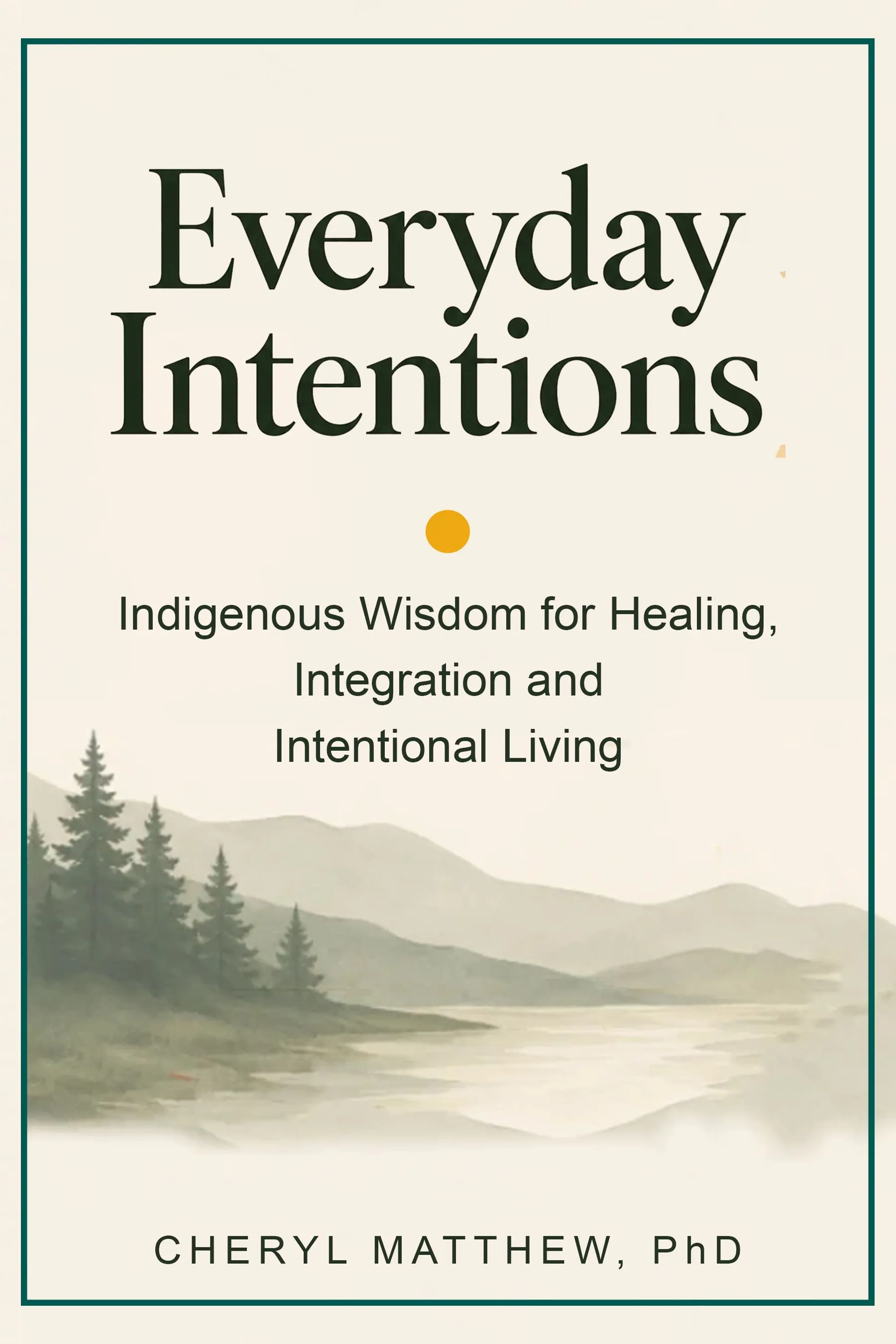
This is why integration expanded in Everyday Intentions: Indigenous Wisdom for Healing, Integration and Intentional Living.
The work is not limited to one kind of transformation or one kind of experience.
It belongs to the ordinary and extraordinary moments that shape us.
It belongs to the quiet morning after a breakthrough.
The first week after a loss.
The uncertain months between identities.
The surprising season of success.
The tender return of happiness.
Integration is not separate from everyday life.
It is how we bring awareness into everyday life.
Grief and loss need room
Loss is not limited to death.
We can grieve a relationship, a role, a home, a community, a dream, a version of ourselves, or a future we once expected.
We can grieve what was harmful and still acknowledge that it was familiar.
We can grieve a difficult chapter while feeling relieved that it has ended.
Several emotions can be true at the same time.
This is part of the complexity of transition.
Grief asks us to slow down enough to recognize what mattered.
It asks us to acknowledge what has changed.
It asks us to discover what remains.
Integration does not rush grief toward a lesson.
It does not require us to call loss a gift before we are ready.
Instead, it creates a relationship with the experience.
We can ask:
What am I carrying?
What am I ready to set down?
What deserves to be remembered?
What support would make today more livable?
These questions do not remove pain.
They help us meet pain with care.
Relationships change when we change
A transition rarely affects only one person.
When we change, our relationships change with us.
A new job can alter our availability.
Healing can change the boundaries we need.
Parenthood, caregiving, illness, retirement, and relocation can reshape our responsibilities.
A growing sense of self can make old patterns feel impossible to continue.
Sometimes relationships deepen through change.
Sometimes they become more complicated.
Sometimes they end.
Integration helps us recognize these shifts without turning every change into a failure.
We can appreciate what a relationship has been while accepting what it can be now.
We can practice communicating new needs.
We can make room for relationships that support our becoming.
We can also learn that belonging does not require abandoning ourselves.
The work is relational.
Our healing affects the people around us.
Their responses affect our healing.
This is why reflection, accountability, cultural safety, and honest conversation matter.
Integration helps us move toward right relationship with ourselves, with others, and with the responsibilities we carry.
Identity shifts deserve attention
Transitions often bring an important question:
Who am I now?
The question can arise after leaving a career, becoming a parent, entering recovery, returning to school, receiving a diagnosis, moving to a new place, or reconnecting with culture and community.
It can also arise when life begins to feel better.
Success can change identity.
Happiness can change identity.
So can peace.
When we have spent years organized around survival, calm may feel unfamiliar.
When we have been known for one role, freedom may feel disorienting.
When an old story no longer fits, we need time to understand what is becoming possible.
Integration is not about choosing between the person you were and the person you are becoming.
It is about learning how the experiences of your life belong together.
Your history matters.
Your present matters.
Your future matters.
You are allowed to grow without rejecting every part of your past.

Healing is not a straight line
Healing is often described as progress.
We may imagine ourselves moving from pain to peace in a smooth, upward direction.
Real healing is usually more rhythmic.
There are returns.
There are pauses.
There are days when an old wound feels close again.
There are moments when a new strength becomes visible.
Integration makes room for this movement.
It helps us notice patterns without assuming that a difficult day means we have lost all progress.
It supports nervous system awareness.
It invites us to attend to the body, not only the mind.
It reminds us that rest, connection, nourishment, movement, reflection, and support can all be part of healing.
A transition may ask for professional care.
It may ask for community support.
It may ask for land-based practices, cultural teachings, creative expression, or a renewed daily rhythm.
There is no single doorway.
There is a practice of listening.
Success and happiness need integration too
We often associate integration with hardship.
That matters.
But positive change also requires adjustment.
A promotion can bring new responsibility.
Financial stability can bring unfamiliar choices.
A healthy relationship can challenge old expectations.
A long-awaited opportunity can create pressure to perform.
Even happiness may feel vulnerable when we are used to preparing for disappointment.
This does not mean we should distrust good experiences.
It means we can receive them consciously.
We can ask:
How do I want to live inside this success?
What values will guide this opportunity?
What kind of happiness feels nourishing rather than performative?
How can I remain connected to my relationships, responsibilities, and sense of self?
Integration allows good things to become part of a grounded life.
It helps us celebrate without losing balance.
It helps us grow without making achievement the measure of our worth.

Making space for what the transition asks of us
Every transition has its own teaching.
Not every teaching arrives as an answer.
Sometimes it arrives as a boundary.
Sometimes as rest.
Sometimes as a conversation we have avoided.
Sometimes as a need to ask for help.
Sometimes as the courage to begin again.
Making space does not mean waiting passively.
It means becoming present enough to respond with intention.
You might begin with a simple check-in across four dimensions of self:
How is my heart?
What is happening in my mind?
What is my body communicating?
Where is my energy going?
The Medicine Wheel self-assessment graphic offers a practical way to notice these areas without reducing your experience to one answer.
A transition may affect every dimension differently.
Your mind may feel clear while your body is exhausted.
Your heart may be grieving while your energy remains high.
You may feel hopeful and afraid in the same hour.
Awareness helps us respond to the whole person.
The evolving companion to everyday life
Everyday Intentions has continued to grow through three connected developments.
The manuscript revisions have deepened the teachings, stories, and practical guidance.
The companion workbook is being designed to help readers turn reflection into practice.
The intention journal is being created as a place to record daily observations, intentions, and returning patterns.
Together, these three forms support the same purpose.
To help wisdom move from the page into life.
To help reflection become relationship.
To help healing become something we return to through ordinary actions.
The book is not a promise that change will become easy.
It is an invitation to meet change with greater awareness, care, and responsibility.
A transition is not only an ending
Change can close a door.
It can open one.
Often, it does both.
Integration helps us stand in that threshold without demanding immediate certainty.
We can honour what has shaped us.
We can acknowledge what hurts.
We can recognize what is strengthening.
We can make choices that reflect who we are becoming.
We can begin again without pretending we are beginning from nothing.
This is the work of intentional living.
One observation.
One conversation.
One boundary.
One breath.
One ordinary decision at a time.
Everyday Intentions: Indigenous Wisdom for Healing, Integration and Intentional Living is Available Now.
To learn more, visit the Everyday Intentions book page. You can also find the book through worldwide retailers or Amazon.
For free downloads, reading resources, and future opportunities from The Wolf Star Press, join the newsletter.
You do not have to rush the transition.
You do not have to understand everything today.
You can begin by noticing what this moment is asking of you.
And then, with care, you can take the next intentional step.